

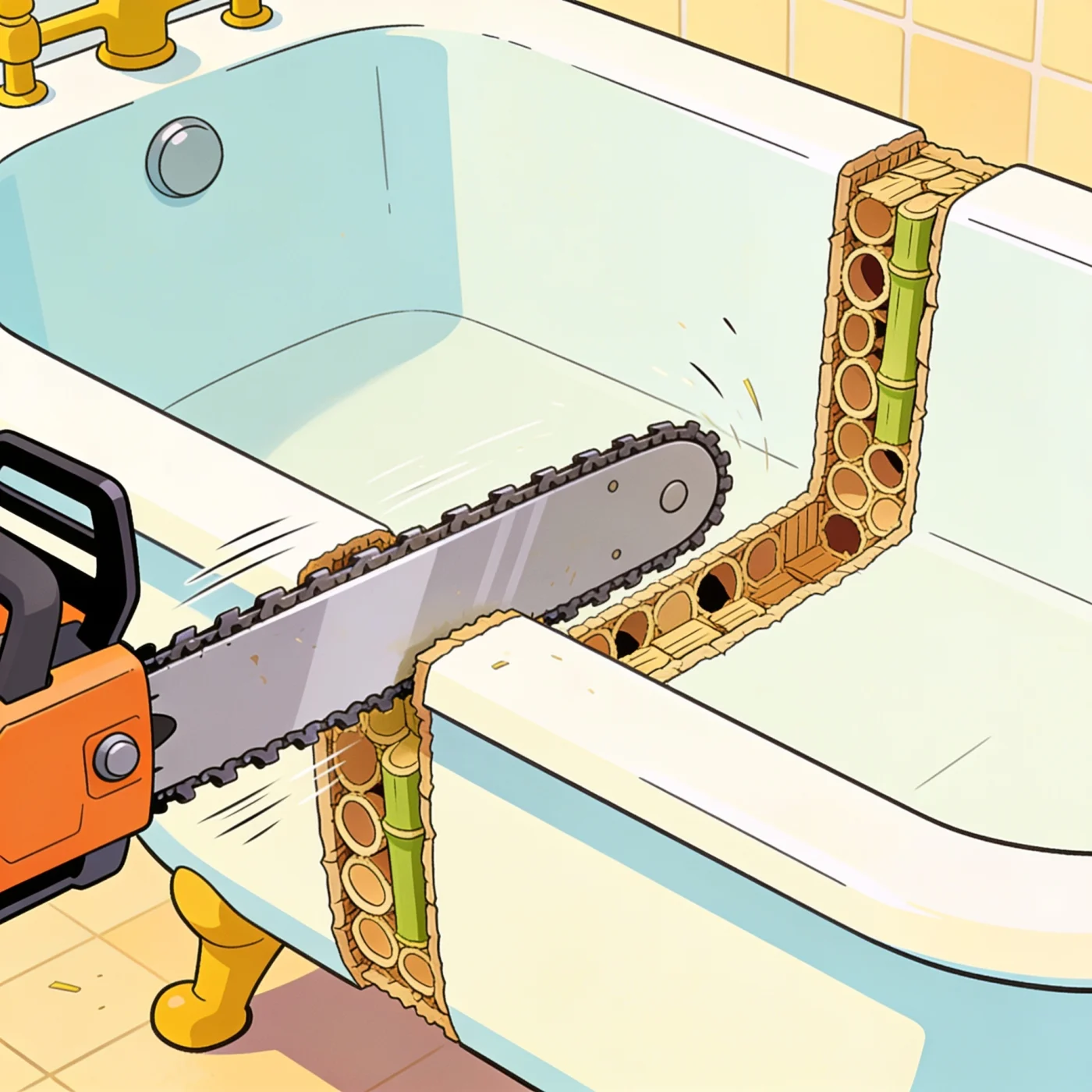
When bathtubs started failing, Jennifer Bylo didn’t accept corporate non-answers. She cut one in half. What she found inside — cheap filler material where solid framing should have been — changed how Bay State Bath sources and stands behind every product it installs in Greater Boston homes.
The Day I Cut A Bathtub In Half – A Case Study Done By Yours Truly
What Happens When Wall Street Decides What Goes Inside Your Bathtub
By Jennifer Bylo, Owner & President, Bay State Bath
I’m a nurse by training. And one thing nurses know – that a lot of industries conveniently forget – is that when something goes wrong, you don’t hide it. You figure out why.
In medicine, they call it a root cause analysis. In my world, I call it an autopsy.
And yes. I once performed an autopsy on a bathtub.
Something Was Wrong With The Tubs
Back when I was working at another bathroom remodeling company, I started getting callbacks. Not a lot at first. Just a tub here and there making a creaking noise. A little flex where there shouldn’t be flex. Customers who had paid good money for a product that was supposed to last a lifetime…and something was off.
I was part of a larger franchise network at the time. And when I raised the issue, I got what you’d expect from a company run by people more focused on profit margins than product quality: a lot of corporate non-answers.
But the callbacks kept coming. And I kept getting madder.
So I did what any reasonable nurse-turned-bathroom-contractor would do.
I cut a tub in half.
What I Found Inside
I took two tubs — one from before the problems started, one from the current batch — and had my guys cut them both open right down the middle. Side by side. Same brand. Same model number. Same box.
Completely different tubs. (I so wish I had taken a photo of this.)
The original? Solid structural framing inside. Built the way it was supposed to be built. The kind of internal support that makes a tub feel solid under your feet and stay that way for decades.
The new one? They had stuffed bamboo between the frame pieces. ACTUAL BAMBOO! Packed in to make the tub feel the same weight when you lifted it, so you’d never know anything was different — until you cut it open or, worse, until it started failing in someone’s home.
I later found out what had happened. The company sourcing the product had gone back to the factory and essentially said: give us the B-level product. Not the A-level. The B-level. Because the B-level is cheaper, and cheaper means better margins, and better margins means happier investors.
The customers paying $15,000 to replace their bathtubs? They didn’t get a vote.
Why This Keeps Happening
Here’s the thing about what happened to those tubs. It’s not a one-time story. It’s the story of what happens to almost every home improvement company that gets bought by outside investors.
The people cutting the checks don’t live here. They don’t know your neighborhood. They’ve never crawled into a 1940s bathroom in Needham or dealt with cast iron pipes in a triple-decker in Worcester. They’re looking at a spreadsheet, and on that spreadsheet, cheaper materials look exactly the same as better materials…until the callbacks start.
And by the time the callbacks start? They’ve already moved on to the next acquisition.
That’s why I left. That’s why I built Bay State Bath from the ground up as an independent, locally owned company. Because I wanted to be the person who was still here when something went wrong, not the person who’d already cashed out.
What We Use Instead
At Bay State Bath, I source our own materials (mostly from BCI and Onyx). I know exactly what’s inside every product we install because I chose it myself. Our tubs and shower systems are commercial grade — not the B-level product, not the version with the bamboo stuffed inside to fake the weight.
And because I’ve been in this market for over 20 years, I know what holds up in New England homes and what doesn’t. Humidity. Temperature swings. Old plumbing. These things eat cheap materials alive.
You don’t get to charge what I charge and deliver what they delivered. That’s not how I operate.
So the next time a bathroom company gives you a price that seems too good to be true, ask yourself what’s inside the tub.
I already know what’s inside mine.
Want to see the materials we use up close? Come visit our showroom or schedule a free design consultation. We’ll show you exactly what you’re getting — before you sign anything.